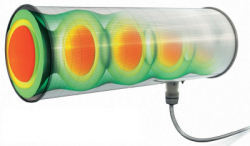
Who'd have thought that a toilet-brush holder, of all things, would turn out to be an excellent Wi-Fi antenna? The lesson is that you can achieve great results for little expense - and half an hour's work.The range of a WiFi router can be considerably extended simply by connecting a directional antenna. Standard omni-directional stub antennas are at the lower end of the performance scale, and they quickly come up against their limits when you need to give your own home better coverage, provide your neighbour with DSL, or pick up as many radio networks as possible while war driving.If the access point is three rooms further on, or even in the house on the other side of the road, you need a directional antenna. If you have to make a connection to your nearest DSL-equipped acquaintance at the other end of the village street, or to bridge even longer radio links to reach the free radio[1] node in the next block but one, you may even require two directional antennas.
Neighbourhood WiFi routers with omni-directional aerials are in any case the worst sources of interference in a city. A single block of flats can easily contain over ten wireless networks, all chattering away simultaneously. Mutual interference is inevitable, with the result that range and connection stability are drastically reduced.Replacing just one of two antennas at the base station can be a way of improving WiFi coverage, for example, down to the bottom of the garden. The near zone is served by the remaining stub. All current WiFi modules automatically use the most suitable antenna for each client, a process called antenna diversity. Even with models having only one external antenna, it's worth having a look inside the casing. Usually, a tiny socket for the second antenna is fitted on the WiFi module. Depending on the manufacturer, this type of plug is called U.FL or Ipex. The connection can easily be led out through a ventilation slot with a short adaptor cable ("pigtail"). On some WiFi notebook cards and USB sticks, there is also an antenna plug, and a look at the data sheet will tell you its type – normally SMA or RPSMA.
The simply made tin-can antenna, with the dimensions given here, is suitable for base stations and for clients who transmit on 2.4 GHz in accordance with the IEEE 802.11b and 802.11g standards. 802.11a uses the 5-GHz band, requiring different antenna dimensions. The necessary background for a recalculation is given in an article on building tin-can radio antenna (Building a Wi-Fi Antenna Out of a Tin Can) [2]
Very recent base stations that comply with the draft standard 802.11n also use the 2.4 GHz band. But they automatically use a number of methods to combine their antennas for optimal range and speed. However, this only works if the antennas have the characteristics expected by the WiFi chipset.
http://www.h-online.com/features/Build-a-Wi-Fi-radio-relay-using-household-materials-747382.html?view=print